How it works
How to play Don’t Land Out
The game is turn-based, but the decisions are recognisably gliding decisions: where to go, how fast to fly, whether to stop, and when to commit to final glide.
1. How to play
Select a MacCready setting to choose your cruise speed. Higher settings fly faster, but lose more height. Lower settings are slower, but make better use of weak lift and reduce your sink.
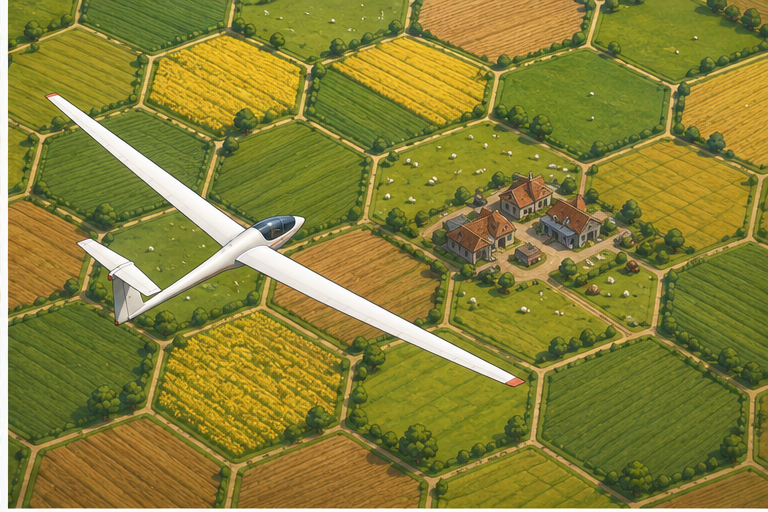
Tap or click an adjacent hex to move. Your time and height loss are calculated from the distance, wind, selected speed, glider polar and the air you pass through.
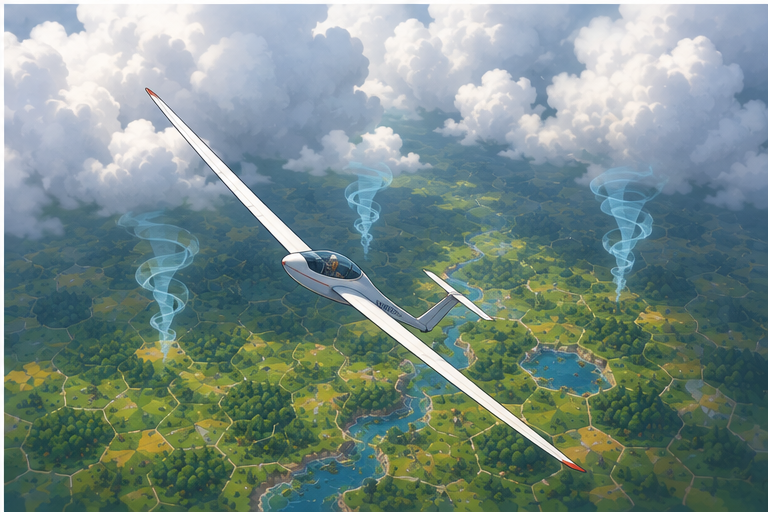
When you reach a cloud, you may get a cockpit-feel cue: turbulent air, a wing lift, or a stronger thermal surge. If you stop and circle, the climb rate becomes known. If you press on, you only keep the hint.
The floating nav boxes show wind, altitude, vario, task speed, next turnpoint, distance and arrival height. On smaller screens, tap them for extra detail, recent move information and speed-setting help.
2. Concepts
Speed to fly
Flying fast is only fast if the next climb justifies the height you spend. The right speed depends on the day, your height, the wind and what you can see ahead.
Using climbs
Not every climb is worth stopping for. A weak climb can save you when low, but ruin your speed when high. Strong climbs are often worth taking properly.
Feeling thermals
Cruising through cloud can give a hint that a core is nearby. You may clip the edge of something strong, or fly cleanly through something average. Circling is the only way to know.
Air masses and routing
Clouds, terrain, wind and blue patches affect the route. The direct line is not always the quickest line if the air is better elsewhere.
Final glide
Once you can get home with the required finish height, every extra climb must justify itself. A fast final glide is often where a task is won or lost.
3. How to go fast
Practice. Real glider pilots do land out; there is an old racing line that says, “if you’re not landing out, you’re not trying hard enough”. The trick is learning when risk is useful and when it is just slow.
Be selective with thermals. If you are high, leave weak climbs alone unless they are exactly on track or the sky ahead looks poor. If you are low, a near-average climb can be gold.
Manage height as a resource. Height gives you choices, but hoarding it costs time. Learn when to leave a climb, when to slow down in lift, and when to speed up through sink.
Route effectively for your height. High pilots can choose the best-looking clouds ahead. Low pilots need nearby options and better terrain. Gliding is not about flying fast; it is about flying efficiently.
Use your speed setting based on what the day has shown you. If the last few climbs have been strong and the sky ahead is organised, higher speed makes sense. If the day is broken, slow down, keep options open and avoid wasting height in dead air.